
What Is the Purpose of a Stablecoin
Ever found yourself staring at the ceiling wondering what is the purpose of a stablecoin? I have. In plain words, it’s a type of digital money whose value is lashed to something steady-like a dollar or gold. The whole point is to stop the psychotic price swings you get with Bitcoin. I like to think of it as the calm friend in a room full of screaming traders. The purpose of a stablecoin is to give you a coin you can spend or save without fear of watching half its value evaporate by lunchtime.
When I first read about this, the core idea hit me: what is the purpose of a stablecoin if not to make crypto usable for normal stuff? Mainstream coins like BTC jump up and down like a kangaroo on espresso, which makes buying coffee or paying rent a terrifying prospect. Stablecoins fix that by hugging a steady price. They offer a bridge between the old money world and the new blockchain world. That bridge is why many folks call them a different digital currency that actually works for daily life.
The source I looked at says stablecoins are linked to fiat cash or reserve assets, which keeps them steady. In a market known for wild moves, the purpose and use of a price-stable asset class is its many use cases-from sending money home to trading without vertigo, they help. I care about this because fees and speed matter to real people. And the main word here stays clear: what is the purpose of a stablecoin? It’s stability, plain and simple.
Stable Money in a Wild Crypto Market

Most crypto coins are like roller coasters. You buy at ten, next day it’s eight, then twelve. Fun for speculators, terrible for payments. The purpose of a stablecoin is to take that roller coaster and turn it into a quiet train ride. They’re designed to maintain a stable value by pegging to fiat currencies or reserve assets. This makes them one of the pillars of the Web3 ecosystem, offering chances for decentralized finance and user adoption.
I think the best way to see it is through the cryptocurrency vs fiat currency debate. On one side you have cash that loses value slowly due to inflation. On the other, crypto that loses value fast due to mood swings. A stablecoin sits in the middle. It’s a crypto payment system that uses the speed of blockchain but the steadiness of the dollar. That’s a big deal for anyone who just wants to pay without checking the price ticker every minute.
Look at the pic above. It shows the idea of a bridge. I feel that image sums up what is the purpose of a stablecoin: connect two worlds. Traditional finance has trust and wide use. Crypto has speed and global reach. Stablecoins mix both. They give a stable store of value, which is essential for everyday transactions. Without that store, you can’t run a shop or get paid reliably on chain.
Binance's Four-Minute Stablecoin Primer
How Stablecoins Bridge Old and New Finance
The core purpose of a stablecoin is mostly about stability. They make it easier to handle global payments, send money home, and trade without the usual crypto price swings. I read that they provide a bridge between traditional finance and the crypto world, which is why they keep gaining users. This bridge is not just talk; it shows up in real use like remittances and store purchases.
What is the purpose of a stablecoin when you already have bank apps? Good question. Banks can be slow and closed on weekends. Stablecoins run on open networks that never sleep. They let you move value like sending an email. That’s a clear win for people who need to act fast. The source notes they’re becoming popular because they offer the stability of traditional currencies and the benefits of cryptocurrencies.
Main use cases I see in the source
- Cross-border payments with low fees and fast settlement
- Remittances sent home without getting robbed by middlemen
- Trading on crypto exchanges without wild price gaps
- Everyday purchases through payment gateways and apps
- DeFi tasks like lending and staking with calm value
Stablecoins are a demonstrated success-crypto’s first killer app.
Different Digital Currency Types and Stablecoins
A different digital currency can mean many things. Some coins aim to be digital gold. Others try to power smart contracts. Stablecoins aim to be digital cash. I find that focus refreshing. They don’t promise to make you rich overnight. They promise to keep your buck worth a buck. That’s the heart of what is the purpose of a stablecoin.
People often ask what are the different cryptocurrencies and where stables fit. The simple answer: there are volatile coins like Bitcoin, and there are stable ones like tokens pinned to the dollar. Some are backed by cash in a bank. Others use crypto as collateral. The source says almost all big stablecoins are linked to the U.S. dollar, which makes them easy to understand.
Cryptocurrency Vs Fiat Currency Made Simple
The talk of cryptocurrency vs fiat currency gets clear when you see stablecoins. Fiat is government money like dollars or euros. Crypto is native to blockchains. Stablecoins are crypto tokens that mimic fiat value. I like this because you get the good parts of both. You can send a stablecoin across the world in minutes, and the receiver sees a value they already trust.
What is the purpose of a stablecoin in this mix? It stops the confusion. If I pay you in Bitcoin, we both worry about the price drop before you cash out. If I pay you in a dollar stablecoin, we both know it is one dollar. That clarity is why shops and freelancers are starting to accept them. The source points out they are a practical alternative to traditional payment methods.
Using Stablecoins for Payments
A good crypto payment system uses stablecoins to avoid price jumps. I have read about merchant tools that accept these coins and save money. For example, Centi Franc is a value-protected stablecoin made for payments. Merchants who take it can save massively compared to credit cards. The source says transaction fees are typically up to 99% cheaper than traditional card transactions.
Then there is the crypto payment processor for business side. Companies like Alchemy Pay and Oobit help shops take stablecoins. Bridges like Celer enable zero-fee transfers and better liquidity. New tools like MEGAFUEL let apps or exchanges pay gas fees for users. That means a buyer can pay with no extra token for network cost. This makes the purpose of a stablecoin show up as real savings.
Why shops like stablecoin payments
- Fees can be up to 99% lower than credit card rates
- Settlement is near instant, no waiting days for clears
- Link to merchant systems is easy and needs no special skills
- Customers gain a global option beyond local banks
- Funds sit in a non-volatile store until spent or cashed
Centi Franc is issued on a highly performant public blockchain with negligible transaction fees.
Animated Breakdown of Peg Mechanisms
Cross-Border Payments and Remittances
One of the most widely adopted uses for stablecoins is cross-border payments. By bypassing legacy rails, they cut remittance fees and enable near-instant settlement. I think this is the part that matters most to real families. Sending cash home should not cost six percent. The World Bank says global remittance rates still average 6.2 percent. Stablecoins shave meaningful basis points off that.
The best consumer use cases are in Africa, the source says. Remittance is the top case, with models like Sling Money popular. Stablecoins let people in unstable currency regimes hold a self-custodied dollar liability. That is huge for folks in Argentina, Nigeria, or Turkey. What is the purpose of a stablecoin there? It is survival with dignity.
The image above shows infrastructure work. BNB Chain works with payment gateways to facilitate everyday purchases. Alliances enable zero-fee transfers. Stablecoin growth is booming in remittance, cross-border, disbursement, and B2B supply chain. I see this as the quiet revolution in moving money. No big bank required.
Remittance benefits from the source
- Faster transaction times than wire or money order
- Lower fees compared to traditional methods
- Access for underbanked populations in remote areas
- Protection from volatile local currencies at home
- Near-instant settlement across borders
Stablecoin Wallets and User Access
Stablecoin wallets are digital wallets that allow users to store, manage, and transfer stablecoins. These wallets give a secure and convenient way to handle coins. I use the idea of a wallet as a phone app that holds value. Centi offers a secure stablecoin wallet that lets users store and manage their Centi Franc via the Centi app, with a friendly interface to transact and track payments.
What is the purpose of a stablecoin if you cannot access it easy? None. So user access matters. The source mentions top wallets like Bitget Wallet and Safepal, plus exchanges like Binance and Gate.io, ensure smooth and gasless transactions. For everyday users, stablecoins function as a more agile and global alternative to a bank account. You can hold funds in a crypto wallet or transact peer-to-peer via decentralized apps.
DeFi and Institutional Use
For banks, asset managers, and hedge funds, stablecoins offer an efficient onramp to decentralized finance without dropping compliance. RLUSD on the XRP Ledger acts as a trusted, regulated stablecoin that institutions can use to post collateral, settle trades, and unlock liquidity. I find that interesting because it brings old finance and new tech together. Hidden Road uses RLUSD as collateral across its global prime brokerage platform.
In the broader DeFi space, stablecoins are used for yield farming, liquidity provision, and collateralization. They also appear in gaming as payment for in-game buys. BNB Chain’s DeFi platforms let users lend, stake, and trade with more confidence. Stablecoins play a crucial role by providing a stable medium of exchange. The source says BNB Chain’s ecosystem includes USDT, USDC, and FDUSD, supporting diversity and lowering risk.
DeFi tasks stablecoins help with
- Lending and borrowing without price fear
- Staking to earn rewards on calm assets
- Trading on decentralized exchanges with peg
- Yield farming and liquidity provision pools
- In-game purchases and micro transactions
Stablecoins are becoming foundational to the tokenization of real-world financial instruments.
Who Benefits From Stablecoins
The source lays out clear winners. Individuals living in unstable currency regimes get self-custodied USD liability. Sophisticated ex-US financial hubs attract founders and capital. Digital nomads get portable savings and simple payroll. The U.S. government gets fiscal help as stables back with short term debt. That last point is wild to me: stablecoins rank around 16th among sovereign holders of such debt.
Opportunities from stablecoins
- People in Argentina, Nigeria, Turkey get steady USD
- UK and Singapore attract crypto founders and funds
- Digital nomads keep portable savings and easy pay
- US fiscally benefits via short term debt backing
- Unbanked gain a simple global account option
Challenges noted in the source
- Foreign governments face spontaneous dollarization
- Banks see narrow banking and disintermediation
- Legacy remitters face margin compression
- Law enforcement worries on cross-border finality
- US security apparatus rethinks sanctions toolkit
What is the purpose of a stablecoin for a nomad? It is a pocket bank with no branch. For a farmer in Kenya, it is a way to receive family funds without losing chunks to fees. The source shows both sides, and I think that balance is honest. No tool is pure good, but the steady coin clearly helps many.
Skeptics and Critics Speak Out
Not everyone cheers. Rohan Grey, a legal scholar who helped author the STABLE Act introduced by Rep. Tlaib in 2020, argues stablecoins are unregulated bank deposits and should be regulated as banks. He described stablecoin issuance as “counterfeiting”. I do not agree with that word, but the worry about private money is real. The source notes counterarguments: issuers are more risk averse, holding short treasuries, and ratings firms help assess risk.
Views on stablecoins from the source
- Skeptical: unregulated bank deposits need bank rules
- Theoretical rejection: Gorton and Zhang 2021 say poor medium
- Engagement: Massad compares to Eurodollars, warns sanctions
- Pro-dollar: Waller says stables strengthen dollar role
- Reserve currency: Brooks says stables add Treasury demand
Stablecoin issuance as “counterfeiting”.
Gary Gorton and Jeffery Zhang wrote “Taming Wildcat Stablecoins” in 2021, comparing stables to free banking crises. They say stables fail the “no questions asked” test. Counterpoint in the source: free banking then was not true free market, and stables hold short term US Treasuries. I read both sides and feel the practice beats the theory so far. Users treat major stables as dollar substitutes.
CNBC on Terra's Collapse and Tether's Secrets
The Dollar and Stablecoins
Some talk about a fed cryptocurrency but most stables are private and dollar-linked. Federal Reserve Governor Chris Waller said about 99 percent of stablecoin market capitalization is linked to the U.S. dollar. That means crypto trades in dollars de facto. I think that is a quiet win for the greenback. Any expansion of DeFi trading just strengthens the dominant role of the dollar.
The source says crypto activity uses stables as medium of exchange and core collateral. This dollarization has been consistent since 2020. Brian Brooks noted stablecoins represent net new dollar exposure backed by short term treasuries. More buy pressure for US debt makes it cheaper to service. Incidents of crypto-dollarization show up in Venezuela, Argentina, Turkey, Nigeria. The purpose of a stablecoin here is to extend dollar use without a bank.
About 99 percent of stablecoin market capitalization is linked to the U.S. dollar.
Blockchain United States and Infrastructure
The blockchain united states use grows as stables spread. BNB Chain aims to become core stablecoin infrastructure in the digital economy. It offers the lowest withdrawal fees for stablecoins across major exchanges. It works with top wallets and centralized exchanges to ensure easy and gasless transactions. The mission is to onboard the next billion users into Web3 by using stablecoins as a price-stable entry point.
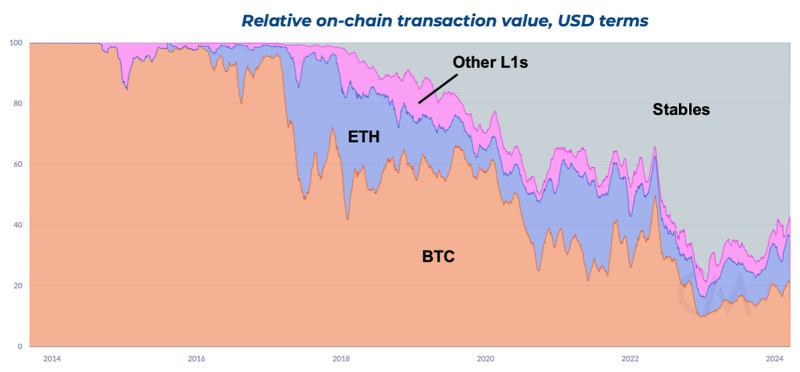
The chart above shows stablecoin settlement value grew from about 40% of on-chain value in 2020 to as much as 80% in 2023. Bitcoin and Ether were historically media of exchange but stablecoins displace them due to volatility frictions. I find that shift telling. The purpose of a stablecoin is to be the rail everyone actually uses. In the U.S. and abroad, the infrastructure keeps building.
Stablecoins issued on high-performance blockchains allow financial providers to meet demand for tokenized fiat. The infrastructure behind RLUSD prioritizes compliance, speed, and settlement finality. These are key requirements for regulated issuers. BNB Chain’s stablecoin ecosystem includes USDT, USDC, and FDUSD. That diversity mitigates risks if one issuer stumbles.
Best Stable Coin to Invest In and Caution
Folks search for best stable coin to invest in but stability is the point, not gain. I would warn: a stablecoin should stay near one dollar, not moon. The source shows almost 100 million addresses on-chain hold stablecoins today. Tether (USDT) is the largest by market cap, with daily trading volume exceeding Bitcoin at times. But you should check backing and issuer trust.
What is the purpose of a stablecoin for an investor? It is a parking spot, not a rocket. RLUSD is fully USD-backed, issued by Ripple on the XRP Ledger, unlike algorithmic stables that can collapse. The source contrasts that with automated monetary policies prone to failure. I care about this because losing savings to a bug is no joke. Pick stables with clear reserves and oversight.
How Is a Blockchain Created and Why It Matters
You might wonder how is a blockchain created and why it matters for stables. In simple terms, it is a shared ledger kept by many computers. Each block links to the last, making records hard to change. Stablecoins ride on this tech to move value without a central clerk. The source mentions public blockchains with negligible transaction fees, like the one Centi Franc uses.
The purpose of a stablecoin depends on that backbone. If the chain is slow or pricey, the coin fails at payments. High-performance chains let stablecoins settle fast and cheap. XRPL and BNB Chain are examples noted in the source. They support native features like auto-bridging and built-in exchanges. That makes stablecoins fit for institutional DeFi and real-time micropayments.
Usd1 Stablecoin Price Chart and Peg Watch
If you look at a usd1 stablecoin price chart you see it stays near one dollar. That flat line is the whole point. The source says stablecoins settle approximately 10 trillion dollars a year, a similar level to Visa. Almost 99 percent of stablecoin market cap is linked to the U.S. dollar. A peg near one buck lets shops price goods without math headaches.
What is the purpose of a stablecoin if the peg breaks? Then it is just another risky coin. The source notes algorithmic stables can collapse, but major fiat-backed ones hold short term treasuries. Ratings firms like Bluechip, S&P, Moodys help assess risk. I suggest watching the chart and the issuer reports. A steady line means the purpose is being met.
My Take on Stablecoin Purpose
I wrote this post because I kept asking what is the purpose of a stablecoin in plain life. The answer from the source is clear: they make global payments less of a nightmare, let you send cash home without fee robbery, and let you trade without crypto vertigo. That matches my own read. A coin that holds value is a coin you can use.
Hey, don’t skip this part: the stability isn’t magic. It comes from backing and rules. Whether it is Centi Franc guaranteed by a bank or RLUSD backed by Ripple, the promise is a calm buck. I like that. The crypto world is loud and fast. Stablecoins are the quiet tool that actually gets the groceries bought. That is the purpose, and it is a good one.















Comments on “What Is the Purpose of a Stablecoin? And How They Work Without Exploding”
No comments yet. Be the first to share your thoughts.